
High-volume businesses need professional hydrojetting because grease and buildup form on pipe walls faster than snaking or in-house cleaning can remove them, and in Michigan a drain failure is more than an inconvenience. A sewage backup is classed as an imminent health hazard for food establishments, which means the operator must stop operating and notify the regulator. Professional commercial hydro jetting works from a camera diagnosis, clears the full pipe interior at commercial pressure, and leaves you with documentation. This guide explains why that matters for restaurants, hotels, multi-tenant buildings, and other busy properties.
Why Commercial Drains Clog Faster
Grease is the main culprit. In its fact sheet on controlling fats, oils, and grease, EPA cites its Report to Congress finding that grease from restaurants, homes, and industrial sources is the most common cause, at 47 percent, of reported sewer blockages, because grease solidifies, reduces conveyance capacity, and blocks flow. EPA also says the collected grease trap waste and uncollected grease reaching treatment plants runs from 800 to 17,000 pounds per year per restaurant.
Commercial lines add their own pressures. According to Bison’s commercial page, commercial drains run 4 to 12 inches in diameter, compared with 1.5 to 4 inches in a home, and they carry heavier loads over longer runs. Floor drains, branch lines, and the main lateral all collect buildup, and a missed year shows up as a thick layer around the full pipe wall.
In Michigan, a Backup Can Stop Your Business
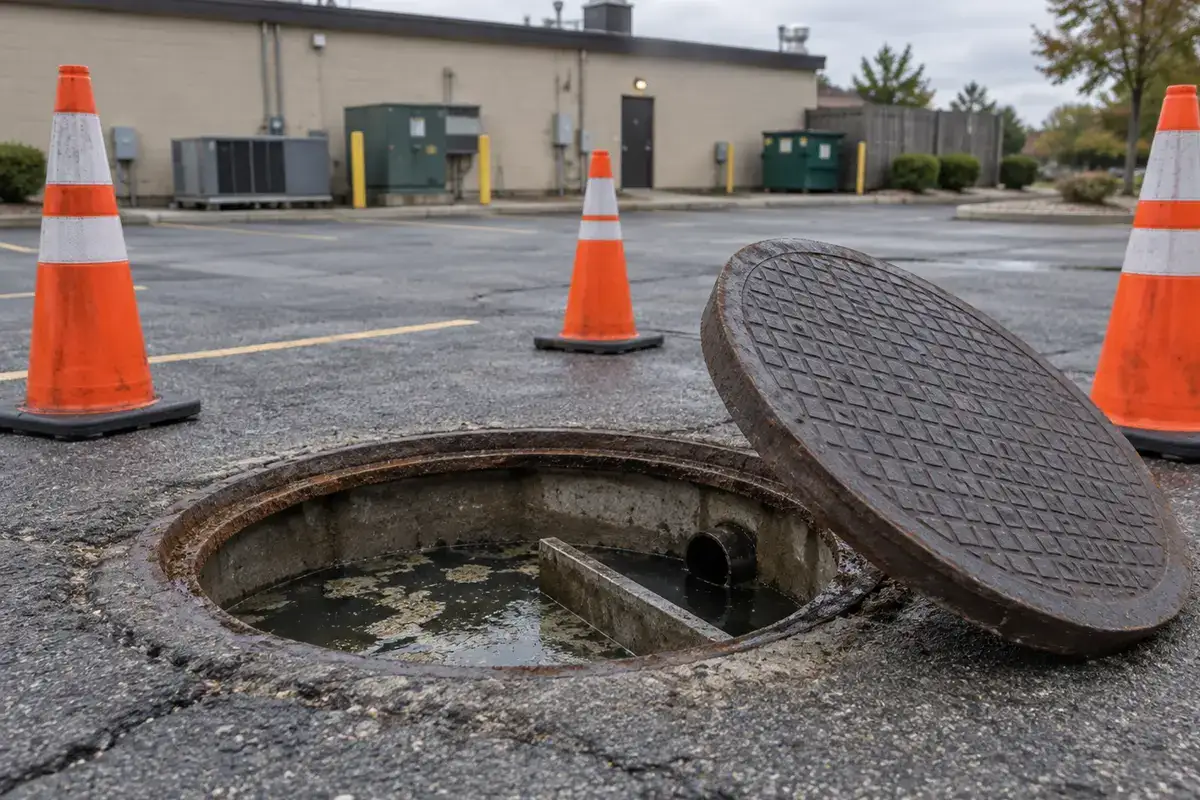
The Michigan Department of Agriculture and Rural Development (MDARD) publishes an imminent health hazard guide for regulators, developed jointly with the Detroit, Macomb County, and Oakland County health departments and the Michigan Restaurant Association. It lists sewage backup among the Food Code’s examples of imminent health hazards. When one affects a single food establishment, the guide says the operator must immediately discontinue operation and notify the regulatory authority. The regulator then assesses the hazard, may allow operations to continue in areas that aren’t affected, and may direct the operator to follow an Emergency Action Plan.
For a restaurant, that can mean closing mid-service. The guide dates to 2004, so confirm the current rules with your local health department, but the underlying point is simple: a drain that backs up is a compliance event, not just a plumbing problem. A documented maintenance schedule is the best way to avoid ever finding out.
What Local FOG Rules Mean for Your Business
Federal rules push this down to the local level. EPA says the National Pretreatment Program prohibits solid or viscous pollutants in amounts that cause obstruction in a sewer system, and that a growing number of local authorities enforce stricter controls on food service establishments. Those can include numeric limits on oil and grease (typically 50 to 450 mg/L, with 100 mg/L the most commonly reported), required grease interceptors, inspections, pumping requirements, and penalties.
EPA’s examples show how far enforcement can go: New York City instituted a $1,000-per-day fine after finding a 73 percent non-compliance rate among restaurants, and some utilities add monthly strong-waste surcharges of $100 to $700 or more. Those are national examples, not Michigan rules. Your local sewer authority and health department set the requirements that apply to you, so ask what they are before an inspector does.
Why Snaking and DIY Cleaning Don’t Hold Up
A snake clears a path through a blockage. Bison’s guide to hydrojetting versus snaking explains the limitation: a snake punches a hole through the clog but rarely removes all the residue from the pipe walls, and that residue becomes the foundation for the next clog. Hydrojetting instead scours the entire interior of the pipe. The same guide notes that consumer pressure washers operate at a fraction of the pressure needed and aren’t the same as professional jetting machines, and that jetting should be done by a licensed plumber after a camera inspection.
| Snaking or DIY Cleaning | Professional Commercial Hydrojetting | |
| What it does | Punches a passage through the blockage; residue can stay on the pipe walls | Scours the full pipe interior with high-pressure water |
| Pipe size | Suited to short, small lines and single-fixture clogs | Built for 4 to 12 inch commercial lines at 4,000 to 5,000+ PSI, per Bison’s commercial page |
| Diagnosis | Often done without looking inside the pipe | Camera first, so a collapsed or cracked line isn’t made worse |
| Records | Rarely any | Before-and-after footage and a service report |
| Risk | Consumer pressure washers aren’t the same as professional jetting machines | High pressure needs training, the right nozzle, and a camera-confirmed pipe |
What Professional Commercial Hydrojetting Involves
Bison’s commercial process, as described on its service page, runs in four steps:
- Site assessment. For new accounts, Bison maps the drain lines, identifies grease interceptor locations, confirms pipe diameters, and assesses how much buildup is present. That sets the schedule and the baseline.
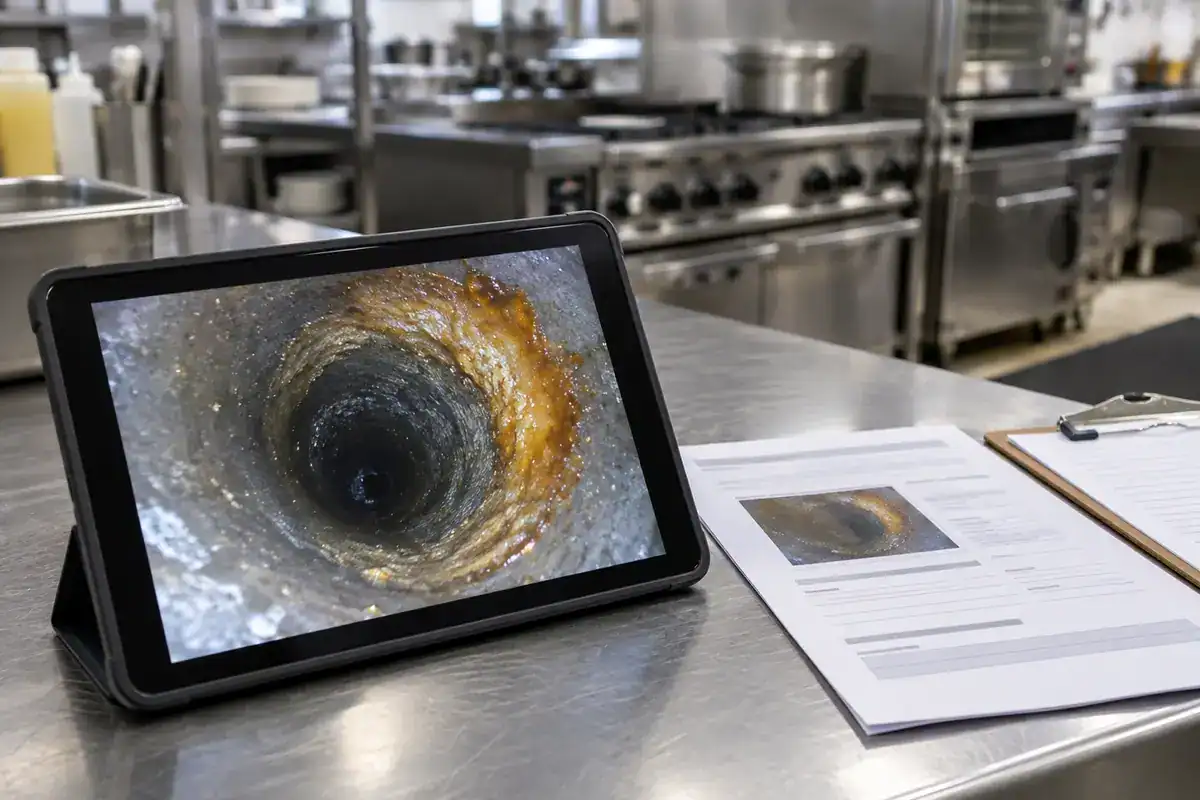
- Camera confirmation. A sewer camera inspection confirms where the buildup is and whether any structural problem would be made worse by high pressure.
- High-pressure jetting. Equipment at 4,000 to 5,000+ PSI runs each line from its access point to the main lateral, using a FOG-cutting nozzle on kitchen lines. Floor drains, branch lines, and the main lateral are cleared in sequence.
- Verification and documentation. A post-jetting camera pass confirms each line is clear, and Bison provides the pre- and post-service footage and a service report for your compliance records.
When jetting isn’t the answer: If the camera shows a collapse or structural break instead of buildup, the recommendation changes. Jetting a failed commercial lateral makes the shutdown longer, not shorter, and a repair is the next step.
Jetting and the Grease Interceptor Work Together
Hydrojetting doesn’t replace a grease interceptor, and a maintained interceptor doesn’t replace jetting. EPA says interceptors must be designed and sized so grease can cool and separate in a non-turbulent environment, and that they have to be serviced at regular intervals, with the frequency depending on how much grease a facility generates and the best management practices it follows. EPA adds that an establishment that adopts good practices can often reduce how frequently its interceptor needs servicing.
Bison’s commercial page makes the complementary point: the interceptor captures grease before it reaches the municipal sewer, but the lines between the kitchen and the interceptor still build up grease that regular jetting clears. Treat the two as one system.
Which Businesses Need It Most
Restaurants are the obvious case, but any property with heavy drain use or shared laterals benefits from a schedule. These are Bison’s starting intervals, and the camera should adjust them for your site:
| Property Type | What Loads the Drains | Bison’s Starting Interval |
| Full-service restaurants | High cooking volume, multiple stations, heavy floor-drain use | Quarterly |
| Fast food and quick service | Fryers and compact kitchens with heavy grease loads | Quarterly to biannual |
| Hotels and event venues | Banquet and kitchen loads during high-occupancy events | Biannual to annual |
| Retail and mixed-use with food tenants | Shared laterals where one tenant’s grease backs up others | Annual to biannual |
| Office buildings | Scale and soap buildup in restroom and break room lines | Biannual |
| Industrial and manufacturing | Solids, oils, and scale in floor and process drains | Annual to biannual |
For a broader look at commercial services and how a recurring schedule fits in, see our guide to commercial plumbing in Oakland County, and for Troy-specific details, our Troy hydro jetting page covers the Big Beaver and Somerset corridor.
How to Choose a Commercial Drain Cleaning Provider
- Confirm the Michigan license. Ask for the license number and check it through the state’s LARA license lookup before you sign.
- Require a camera before and after. A provider who jets without looking inside the line is guessing.
- Ask for documentation. Footage and a service report give you a record for inspectors and for your own files.
- Ask how the schedule is set. It should come from your cooking volume and what the camera shows, not a generic calendar.
- Confirm emergency response. You want one contractor who handles both scheduled maintenance and a prompt, business-hours sewer backup response.
- Get the scope in writing. It should name the lines, the method, and what’s included.
What Drives the Cost
Commercial hydro jetting is priced by scope, not a flat rate. The main drivers are pipe diameter and run length, access (an interior cleanout is quicker than reaching a lateral from a yard or street access), how much buildup or damage the camera finds, and timing, since scheduled off-hours work is priced differently from work during regular business hours. Bison also offers recurring contracts at a reduced per-visit rate compared with one-off calls. See the commercial hydro jetting page for current pricing, or request a quote for your property. Bison’s broader commercial plumbing services cover the other systems on the same lines.
Frequently Asked Questions
Why do high-volume businesses need professional hydrojetting instead of snaking?
Snaking clears a path through a blockage but can leave residue on the pipe walls, which becomes the start of the next clog. Professional hydrojetting scours the full interior of commercial-size lines at 4,000 to 5,000+ PSI, with a camera before and after to confirm the result.
Can a drain backup shut a Michigan restaurant down?
It can. MDARD’s guide lists sewage backup among the Food Code’s imminent health hazards and says the operator must immediately discontinue operation and notify the regulatory authority. The regulator then assesses the hazard and decides whether any operations can continue. Confirm current requirements with your local health department.
How often should commercial drains be jetted?
Bison recommends quarterly jetting for full-service restaurants and high-volume kitchens, biannual for offices and lower-volume food service, and annual for light commercial properties. The interval should be set from your cooking volume and what the camera shows.
Does hydrojetting replace grease trap or interceptor service?
No. EPA says grease interceptors have to be serviced at regular intervals, with the frequency depending on how much grease a facility generates. Jetting clears the lines between your kitchen and the interceptor, and the interceptor captures grease before it reaches the sewer. You need both.
Is hydrojetting safe for older commercial pipes?
It can be, when a camera inspection comes first. High pressure can worsen cracked or collapsed pipe, so a camera confirms the pipe’s condition before jetting. If the camera finds a collapse, the recommendation changes from cleaning to repair. When a line is damaged but still holds its shape, CIPP pipe lining can rehabilitate it from the inside without opening a trench.
What records should I keep after a jetting service?
Keep the pre- and post-service camera footage and the service report. Bison provides both with every commercial job, and they give you a maintenance record to show a health inspector or local sewer authority.
Does Bison serve my area?
Bison serves commercial properties across Macomb and Oakland County, including the Troy Somerset Collection and Big Beaver corridor, Auburn Hills, Warren’s Van Dyke and Mound Road corridors, Birmingham, Royal Oak, Rochester Hills, and Sterling Heights.
Commercial drains don’t fail on a convenient schedule, and in Michigan a backup can end a service. The properties that run smoothly are on a documented schedule with a camera-confirmed baseline. Start with a camera inspection, set the interval from your real volume, and keep the records.
Bison Plumbing: Commercial Drain Maintenance for Macomb and Oakland County Since 1998
Bison Plumbing is a family-owned, Michigan LARA-licensed plumbing and sewer company based in Warren. It checks every commercial line with a camera before and after jetting, and provides the footage and a service report for your records.
Call or request a quote to talk through your property’s drains and the right maintenance schedule.
Need a commercial hydrojetting schedule?
Start with a camera inspection and a site assessment. Bison sets the schedule from your actual kitchen or building volume, and documents every visit.
Schedule Commercial Hydro Jetting | (248) 247-7707