

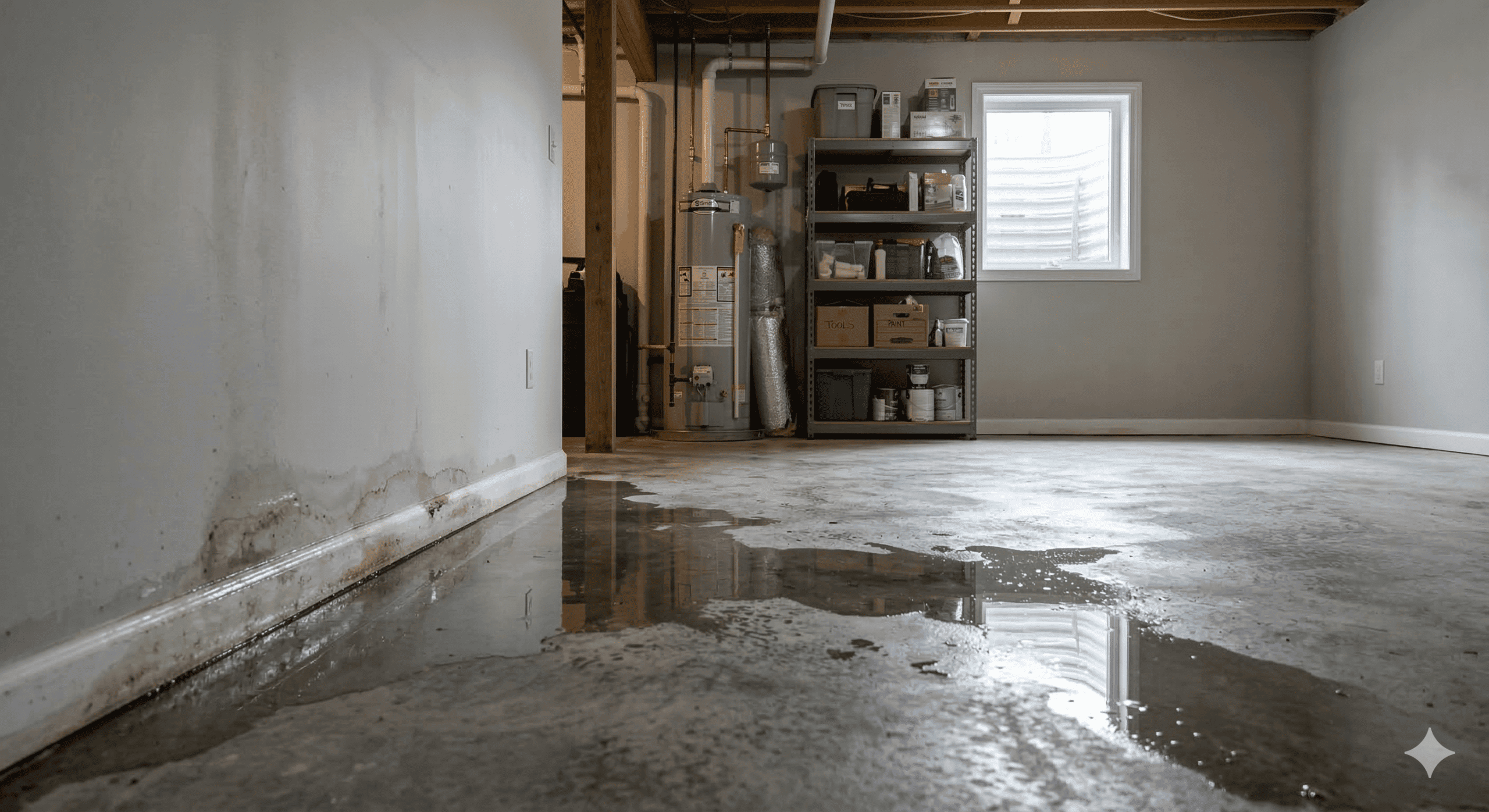
The most common causes of water in a basement include foundation cracks under hydrostatic pressure, improper soil grading, clogged gutters and downspouts, sump pump failure, sewer or floor drain backup, leaking interior pipes, window well flooding, a high groundwater table, and condensation. In Warren, MI, aging cast iron sewer lines and Michigan's freeze-thaw cycles make plumbing-related basement water intrusion especially common. Identifying the source correctly is critical — the fix for a sewer backup is completely different from the fix for a foundation crack. A professional sewer inspection or plumbing evaluation is the fastest way to find the exact cause and stop the water for good.
Finding water in your basement is one of the most unsettling discoveries a homeowner can make. Whether it's a small puddle near the floor drain, water streaking down the foundation wall, or an inch of standing water after a heavy Michigan rainstorm, the problem demands an immediate answer: where is it coming from?
The answer matters enormously — because water in basement situations don't all have the same cause, and the right fix depends entirely on diagnosing the true source. A homeowner who waterproofs their foundation when the real problem is a failing sump pump has wasted thousands of dollars. A homeowner who blames condensation when the real culprit is a sewer backup is risking their family's health.
This guide walks through all 9 causes of water in a basement that Warren, MI homeowners encounter most frequently — with the plumbing-related causes receiving special attention, since Bison Plumbing sees those issues at the root of many basement water complaints throughout Macomb County. We'll cover what each cause looks like, why it happens, and what the right repair solution is.
1 Foundation Cracks and Hydrostatic Pressure
Foundation cracks are among the most common structural causes of water in basement problems. When soil surrounding your home becomes saturated — after heavy rain, snowmelt, or a period of high groundwater — it exerts outward force against your basement walls and floor. This force, called hydrostatic pressure, pushes water through any available opening: hairline cracks in poured concrete, deteriorating mortar joints in concrete block walls, and the cold joint where the wall meets the floor.
In Warren, MI, freeze-thaw cycles accelerate this process significantly. Water that seeps into a small foundation crack in autumn freezes and expands in winter, widening the crack. By spring thaw, what was once a minor imperfection becomes a reliable water entry point. Homes built before 1980 — which represent a large portion of Warren's residential housing stock — are especially susceptible because original waterproofing membranes on the exterior of the foundation have long since degraded.
Look for: horizontal streaks of efflorescence (white mineral deposits) on basement walls, water appearing at the base of walls after rain, or visible cracks running vertically, horizontally, or diagonally through the foundation.
Horizontal cracks in a poured concrete or block foundation wall are a structural red flag — they can indicate inward bowing caused by soil pressure and require professional evaluation beyond simple crack sealing.
2 Improper Soil Grading Around the Home
Every home's foundation depends on proper grading — the slope of the soil immediately surrounding the home — to direct rainwater and snowmelt away from the structure rather than toward it. Current building codes require the soil to slope at least 6 inches downward within the first 10 feet from the foundation wall.
Over time, soil settles. Landscaping projects disturb the original grade. Mulch and garden beds build up against the foundation, creating a bowl that traps water right where you least want it. When water pools against the foundation and has nowhere to go, it works its way into the basement through any available path — cracks, porous concrete, or the floor-wall joint.
According to the University of Minnesota Extension's guidance on basement moisture, failure to slope the ground surface away from the foundation is one of the most common construction-related causes of ongoing basement water problems — and one of the most correctable.
Walk around your home's perimeter after a rain. If you can see water pooling within 5 feet of the foundation walls, improper grading is almost certainly contributing to your basement water problem. Regrading is often a straightforward and cost-effective fix.

3 Clogged Gutters and Misdirected Downspouts
Your home's gutter and downspout system has one job: collect roof runoff and carry it far away from the foundation. When that system fails — because gutters are clogged with leaves, downspouts are blocked or too short, or the downspout discharge point sits too close to the house — hundreds of gallons of water per rainstorm end up exactly where they shouldn't: saturating the soil directly against the foundation.
In a single 1-inch rainfall, a 2,000-square-foot home sheds approximately 1,250 gallons of water from its roof surface. Without properly functioning gutters and downspouts, a meaningful portion of that volume ends up working its way toward your basement. Downspouts should ideally discharge at least 6–10 feet from the foundation, and extension pipes or underground pop-up drains can help ensure proper discharge distance.
Check your gutters at least twice a year — once in late spring and once in early fall — and especially before Michigan's heavy spring thaw season when large volumes of snowmelt combine with rain.
If you notice water in your basement only during or after rain events — not during dry periods — a clogged gutter or short downspout is high on the suspect list. The fix is often as simple as cleaning the gutters and adding a downspout extension.
4 Sump Pump Failure
The sump pump is your basement's last line of defense against groundwater intrusion. It sits at the lowest point of your home in a pit (the sump pit), collects water that naturally migrates toward the foundation, and pumps it out and away from the house before it can rise and flood the basement floor. When this pump fails — due to a power outage, a burned-out motor, a stuck float switch, or simply old age — basement flooding can happen rapidly, especially during heavy rainstorms or spring snowmelt events.
A sump pump that's over 7–10 years old, runs constantly, makes grinding or rattling noises, or never seems to turn on at all is showing signs it may be reaching the end of its service life. A failed sump pump during a storm event is one of the most common emergency calls Bison Plumbing receives from Warren homeowners — and it's almost entirely preventable with regular testing and a backup system.
Consider adding a battery-powered or water-powered backup sump pump to protect your basement during power outages — which are common in Macomb County during severe storms. Learn more about battery-powered vs. water-powered backup sump pumps and which type is right for your home.
Test your sump pump every spring before storm season begins: pour a bucket of water into the sump pit and confirm the pump activates and discharges properly. If the pump doesn't kick on, or runs but doesn't remove water efficiently, it's time to call a plumber. Read our guide on when to repair or replace your sump pump.

Corroded and cracked cast iron sewer pipes — a common find beneath Warren, MI homes built before 1980.
Why Warren, MI Basements Are Especially Vulnerable
Warren's residential neighborhoods were largely built between the 1950s and 1980s — a period when clay tile and cast iron sewer pipes were the standard, and basement waterproofing practices were far less sophisticated than they are today.
Cast iron and clay pipes have a lifespan of 50–100 years, meaning thousands of Warren homes are either at or past the useful life of their original sewer infrastructure. When these pipes corrode, crack, or collapse, the resulting backups and underground leaks frequently surface in the basement first.
Michigan's freeze-thaw cycles compound every other cause on this list — expanding cracks in foundations, shifting soil grade, and stressing pipe joints year after year. If your home is more than 40 years old, a proactive sewer system check-up can prevent the majority of plumbing-related basement water problems before they start.
5 Sewer Line Backup or Floor Drain Overflow
A sewer backup is one of the most dangerous and costly causes of water in a basement — and unlike the other causes on this list, the water it brings in isn't clean. When your main sewer line is blocked by grease buildup, tree root intrusion, a collapsed pipe section, or an overwhelmed municipal sewer system during heavy rain, wastewater has nowhere to go but backward. It reverses direction through the drain pipes and surfaces through the lowest-elevation fixture in the home — almost always the basement floor drain.
The warning signs that often precede a full backup include gurgling sounds from the basement floor drain or basement toilet, slow drains throughout the house, and a faint sewer gas odor near floor-level fixtures. If you've noticed any of these symptoms and then discovered water in your basement — especially water that smells, appears discolored, or surfaces directly from the floor drain — treat this as a plumbing emergency.
Do not run water, flush toilets, or use any appliances until the line has been professionally cleared. Learn about preventing sewer backups and what to do when they occur. For homes with aging cast iron sewer systems, cast iron pipe replacement in Warren, MI is often the most permanent solution to recurring backups.
Sewage backup water is classified as "black water" — it contains harmful bacteria, pathogens, and viruses. Do not attempt to clean this up yourself without proper protective equipment, and do not allow children or pets into the affected area. Professional remediation is strongly recommended.
6 Leaking or Burst Interior Pipes
Not all water in basement situations originate from outside the home. Interior plumbing failures — leaking supply lines, corroded drain connections, a sweating water heater, or a burst pipe following a freeze — can introduce significant water into basement spaces quickly. These leaks often go undetected for extended periods because basement areas are less frequently visited than main living spaces, and a slow drip can do enormous damage over weeks or months before it becomes visible.
Burst pipes are the single most common cause of indoor water damage nationwide, and in Michigan's winters, freezing is the primary culprit. Water expands by approximately 9% as it freezes, and that expansion is powerful enough to rupture even copper or PVC pipe. Pipes running along exterior basement walls, through unheated crawl spaces, or near the sill plate are most vulnerable. Learn how to insulate your pipes before they freeze to prevent this entirely.
For older Warren homes with cast iron drain pipes, corrosion-related leaks at joints and fittings are also increasingly common. These leaks are often slow and intermittent — enough to create persistent dampness and mold without ever producing visible standing water.
If water in your basement appears regardless of weather conditions — whether it's dry or raining outside — an interior pipe leak is likely. Check under and around your water heater, washing machine connections, and any visible pipe runs along the basement ceiling or walls. Our plumbing repair team can trace the source quickly.

7 Window Well Flooding
Basement egress windows require window wells — the curved metal or plastic structures that hold back soil and allow light to reach below-grade windows. When a window well fills with water — due to heavy rain, clogged drains, or inadequate depth — that water pushes directly against the basement window frame. Older windows with deteriorating seals, failing caulk, or damaged frames will allow that water to pour into the basement.
This cause of water in basement problems is extremely common in Warren, MI homes that had egress windows added during basement finishing projects, where the window well may not have been installed with adequate drainage or gravel backfill below the well to allow water to percolate down. Leaves and debris accumulate in window wells quickly during Michigan's fall season and can create an effective dam.
Install polycarbonate window well covers to keep debris, leaves, and heavy rain out of window wells. Make sure window wells have at least 6 inches of gravel at the bottom for drainage. Clear the well area after every major storm and inspect window seals annually before spring thaw.
8 High Groundwater Table
In some Warren, MI neighborhoods — particularly in low-lying areas or those near drainage channels — the groundwater table can rise seasonally to a level that's very close to, or even above, the basement floor elevation. When this happens, water doesn't need a crack in the wall or a gap around a window to get in. It seeps upward through the porous concrete floor slab itself, driven by the pressure of saturated soil below.
Signs of a high water table as the cause include water appearing across a broad area of the basement floor (rather than at one specific point), water appearing during or immediately after snowmelt in spring even without heavy rain, and water that seems to "sweat" up through the slab. According to State Farm's guidance on flooded basement causes, hydrostatic pressure from a high water table is one of the more difficult and expensive basement water problems to address — because it requires managing water pressure at the source rather than simply sealing entry points.
A functioning interior drain tile system (French drain beneath the floor slab) paired with a properly sized sump pump is the standard engineering solution for high groundwater table issues. Surface sealing alone will not solve this problem — the pressure will simply find another entry point.
9 Condensation and Interior Humidity
Not every wet basement is the result of water coming in from outside. Condensation — moisture that forms when warm, humid air contacts cool basement walls and floors — can create surprisingly large amounts of surface moisture that homeowners mistake for a water leak. This is especially common in Warren-area homes during summer, when homeowners open basement windows for ventilation but inadvertently let in warm, humid Michigan summer air that immediately condenses on the cool concrete surfaces below.
You can distinguish condensation from seepage with a simple test: tape a piece of plastic sheeting to a suspect wall area and seal all four edges with tape. Leave it for 24–48 hours. If moisture forms on the outer face of the plastic (the room side), the source is condensation. If moisture forms behind the plastic (between the plastic and the wall), the source is water coming through the wall itself.
As noted by the University of Minnesota Extension, condensation can also occur through capillary suction — where moisture is drawn upward through porous concrete from the soil below, often creating a ring of dampness at the base of basement walls.
A properly sized dehumidifier running continuously in a finished or semi-finished basement can manage condensation effectively. Insulating basement walls also raises their surface temperature, reducing the temperature differential that causes condensation. However, if insulation is added before addressing true water intrusion, it will trap moisture and accelerate mold growth.
What Warren, MI Homeowners Should Do When They Find Water in the Basement
The right repair depends entirely on the right diagnosis. Many homeowners spend money on the wrong fix — sealing walls when the problem is a sewer backup, or replacing a sump pump when the problem is a downspout draining too close to the foundation. Here is how Bison Plumbing approaches basement water problems, and the services available to address each cause.
Sewer Camera Inspection
When a sewer backup or floor drain overflow is suspected, a waterproof video camera fed through your drain line pinpoints blockages, root intrusion, pipe collapse, and joint failures — without any digging. This is always the first step for plumbing-related basement water. See our sewer and drain services.
Drain Cleaning & Hydro Jetting
For sewer blockages and slow floor drains caused by grease, debris, or root infiltration, high-pressure hydro jetting scours pipe walls clean — far more effective than snaking for established buildup. Also ideal for proactive maintenance before a backup occurs.
Trenchless Pipe Lining (CIPP)
For cracked or root-invaded sewer lines causing recurring backups, trenchless cured-in-place pipe lining restores full pipe integrity without excavation. Explore no-dig sewer repair options. The new liner also eliminates root re-entry points permanently.
Pipe Bursting & Sewer Replacement
When a pipe is too deteriorated to line, pipe bursting pulls a new pipe into position while fracturing the old one — no open trenches. For severe collapses, full trenchless sewer replacement may be the most permanent and cost-effective resolution.
Interior Pipe Repair
For leaking supply lines, corroded cast iron drain connections, or burst pipes inside the home, Bison Plumbing's team traces the leak to its source and makes a lasting repair. View our plumbing repair services — we handle everything from minor drips to full cast iron replacement.
Drain Cleaning Services
Recurring slow drains, persistent basement floor drain backups, and post-storm floor drain overflows often respond well to professional drain cleaning services that go deeper than a plunger or store-bought chemical can reach. Learn more about clogged drain solutions.

Unlike structural waterproofing or foundation repair — which falls outside Bison Plumbing's scope — all plumbing-related basement water causes are squarely in our area of expertise. If a camera inspection reveals a plumbing problem is at the root of your basement water issue, we can resolve it the same day in many cases. If the inspection reveals the cause is structural (foundation cracks, grading, or window wells), we'll tell you that clearly and help you understand what type of contractor to call next.
Does Homeowner's Insurance Cover Water in the Basement?
Coverage depends entirely on the cause. Standard homeowner's policies generally cover sudden and accidental water damage — such as a burst pipe. They typically do not cover flooding from surface water, gradual seepage through foundation cracks, or groundwater intrusion. Sewer backup damage is also excluded from most standard policies unless you've added a sewer backup endorsement to your coverage.
Given the frequency of sewer backup events in Macomb County — particularly during heavy spring rainfall when the municipal sewer system becomes overtaxed — a sewer backup rider is worth considering for Warren homeowners. The annual cost is typically modest compared to the out-of-pocket expense of a sewage cleanup and pipe repair.
Found Water in Your Basement? Let's Find Out Where It's Coming From.
Bison Plumbing has been diagnosing and resolving plumbing-related basement water problems in Warren, Sterling Heights, and throughout Macomb County for over 25 years. We offer sewer camera inspections, drain cleaning, hydro jetting, and trenchless sewer repair — with upfront pricing and no-surprise billing.
Schedule a Basement Water Evaluation Or call us directly — we answer fastThe 9 Causes of Water in Basement: A Quick Summary
- Foundation cracks under hydrostatic pressure allow water to push through the walls and floor-wall joint — especially after Michigan's freeze-thaw cycles widen existing cracks.
- Improper soil grading directs rainwater and snowmelt toward the foundation rather than away from it — one of the most common and most correctable causes.
- Clogged gutters and short downspouts dump large volumes of roof runoff against the foundation during every rainstorm — clean gutters twice yearly as a minimum.
- Sump pump failure is the most preventable cause of basement flooding — test your pump every spring and consider adding a battery backup system.
- Sewer or floor drain backup brings sewage-contaminated water into the basement and is a plumbing emergency — stop all water use and call immediately.
- Interior pipe leaks — especially from aging cast iron drain connections or frozen supply pipes — can create persistent dampness that builds to visible water over time.
- Window well flooding occurs when wells fill with rain or debris and press water against below-grade window frames — covers and gravel drainage prevent it.
- High groundwater table forces water up through the floor slab itself — requires an interior drain tile system and properly sized sump pump to manage.
- Condensation is often mistaken for a leak — use the plastic sheeting test to distinguish surface moisture from true water intrusion before investing in waterproofing.
Frequently Asked Questions: Water in Basement Causes in Warren, MI
The most common causes are foundation cracks under hydrostatic pressure, improper soil grading, clogged gutters and downspouts, sump pump failure, sewer or floor drain backup, interior pipe leaks, window well flooding, high groundwater table, and condensation. In Warren, MI, plumbing-related causes — particularly sewer backups and failing cast iron pipes — are especially prevalent given the age of the housing stock.
Look for clues in the pattern: water appearing only after rain points to surface or drainage issues; water that comes from the floor drain suggests a sewer backup; water under appliances or near pipe fittings indicates an interior leak; water that appears in dry weather may be groundwater; and moisture that forms on wall surfaces during summer is often condensation. A professional sewer camera inspection is the fastest and most reliable way to rule out plumbing-related causes.
Yes — and it's one of the most dangerous causes because the water involved is sewage-contaminated. When the main sewer line is blocked or the municipal system backs up during heavy rain, wastewater reverses course and surfaces through the basement floor drain — the lowest drain in the home. This is a plumbing emergency that requires immediate professional attention and proper cleanup to prevent health hazards.
Standard homeowner's policies cover sudden and accidental damage — like a burst pipe — but typically exclude gradual seepage, groundwater flooding, and sewer backup unless you've added a sewer backup rider. Given how frequently sewer-related basement flooding occurs in Macomb County, a sewer backup endorsement is often worth the added premium cost.
Costs vary significantly by cause: professional drain cleaning runs $200–$600; sump pump replacement typically costs $500–$1,500 installed; trenchless pipe lining ranges from $80–$250 per linear foot; and full sewer line replacement in the Warren and Macomb County area generally falls between $3,000 and $15,000 depending on pipe length and depth. A camera inspection first ensures you only pay for the repair that's actually needed — not a guess.
Prevention depends on the root cause: maintain and test your sump pump annually, clean gutters each spring and fall, ensure soil grades away from the foundation, install window well covers, seal visible foundation cracks, and have your sewer line camera-inspected every 3–5 years if your home is over 30 years old. Warren homes with aging cast iron sewer systems benefit most from proactive trenchless pipe lining before a backup forces an emergency repair.
First, shut off electricity to the basement if there's standing water near any electrical panel, outlets, or appliances — water and electricity are a life-threatening combination. If the water smells like sewage or is coming from the floor drain, stop all water use in the house immediately and call a plumber. Do not run laundry, flush toilets, or use the dishwasher. Document the damage with photos before cleanup begins, and contact your insurance company to understand your coverage. Then call Bison Plumbing at (586) 997-9000 for a same-day assessment.
Research sources: University of Minnesota Extension — Moisture in Basements: Causes and Solutions · State Farm — Flooded Basement Common Causes · HouseCashin — Home Water Damage Statistics