

Choose pipe patching when one short, isolated section of your sewer line is damaged, and choose pipe lining when the whole pipe is failing. A pipe patch seals a single crack, offset joint, or root entry point for roughly $500–$1,800 and installs in hours. CIPP pipe lining rebuilds the entire pipe from the inside, lasts 50+ years, and typically runs $6,000–$12,000+ for a full lateral. A camera inspection is the only reliable way to know which one your Michigan home actually needs.
If a plumber has told you your sewer line is damaged, you’ve probably heard two trenchless options thrown around: pipe patching and pipe lining. They sound similar, they’re both “no-dig,” and they both fix broken pipe without tearing up your yard. But they solve very different problems — and picking the wrong one means either overpaying for repairs you don’t need or applying a band-aid to a pipe that’s failing end to end.
This guide breaks down exactly how each method works, what they cost in Michigan in 2026, how long they last, and the simple rule that tells you which one your home actually needs. By the end, you’ll be able to read a repair quote and know whether it matches the real condition of your pipe.
What’s the difference between pipe patching and pipe lining?
Both methods are forms of trenchless sewer repair — they rebuild a pipe from the inside using a resin-saturated liner, with no need to excavate your lawn or driveway. The difference comes down to how much of the pipe gets repaired.
Pipe patching (also called a spot repair or sectional liner) repairs a single short section of pipe — usually 2 to 4 feet — where one specific defect exists. Pipe lining, technically known as CIPP (cured-in-place pipe), repairs the entire run of pipe from one access point to the next, creating a continuous new pipe inside the old one.
Think of it like a damaged section of road. Patching is like filling one pothole. Lining is like repaving the whole street. If you have a single pothole, repaving is overkill. But if the entire road is crumbling, filling one hole at a time is a losing battle.
How does pipe patching work?
A spot repair targets one localized problem. After a camera inspection pinpoints the exact location and length of the damage, the process is straightforward:
- The line is cleaned and any roots or debris are cleared, often with hydrojetting.
- A short fiberglass or felt patch is saturated with epoxy resin and positioned over the damaged section using an inflatable bladder.
- The bladder presses the patch tightly against the pipe wall while the resin cures.
- Once cured, the bladder is removed, leaving a smooth, sealed repair bonded to the original pipe.
The whole job is usually completed in a few hours. Patching is ideal for an isolated crack, a single separated joint, or one point where tree roots have intruded — as long as the rest of the pipe is structurally sound.
A patch is only as good as the pipe around it. If the surrounding pipe is also deteriorating, a spot repair can fail at the edges within a few years — which is why a camera inspection before patching isn’t optional, it’s essential.
How does pipe lining (CIPP) work?
CIPP lining rebuilds the full length of the pipe. Instead of a short patch, a flexible liner saturated with resin is inserted through an existing access point, inflated against the pipe walls along the entire run, and cured in place to form a seamless, jointless new pipe inside the old one.
Because the new liner has no joints — the most common failure point in old clay and cast iron sewer lines — it eliminates the gaps where roots invade and where cracks start. The cured liner meets ASTM F1216 and F1743 standards, the industry benchmarks that govern CIPP material performance and the documented 50-year design life. Most full-lateral lining jobs are completed in a single day. Industry bodies like NASSCO have standardized these rehabilitation methods nationwide.
Lining is the right call when damage is widespread, the pipe material is at the end of its life, or you’ve had repeated problems along different sections of the same line. For severely collapsed pipe that a liner can’t restore, the alternative is trenchless sewer replacement (pipe bursting) — we compare those two methods in our pipe lining vs. pipe bursting guide.
Pipe patching vs pipe lining: which one do you actually need?
Here’s the decision in plain terms. The right method depends almost entirely on how much of your pipe is damaged and what condition the rest of the line is in.
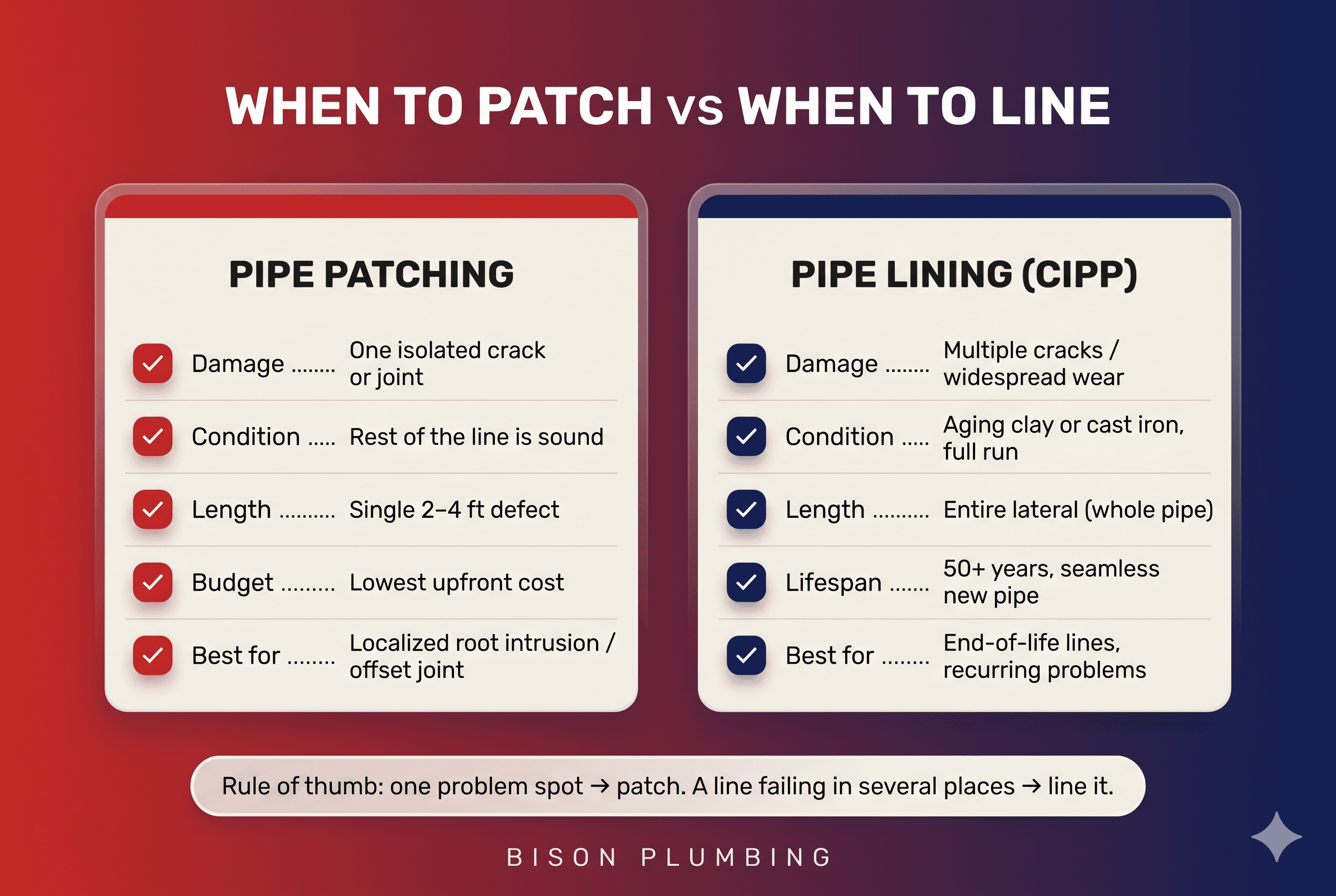
✅ Pipe Patching Is Right When…
- You have one isolated defect — a single crack or offset joint
- The rest of the pipe is structurally sound
- The damage spans a short 2–4 ft section
- Roots entered at a single point
- You want the lowest upfront cost for a real fix
✅ Pipe Lining Is Right When…
- There are multiple cracks or widespread wear
- The pipe is aging clay or cast iron nearing end of life
- You’ve had repeat backups in the same line
- Roots are intruding at several joints
- You want a 50+ year one-and-done solution
The simplest rule of thumb: one problem spot, patch it. A line failing in several places, line it. Patching a pipe that’s deteriorating throughout just moves the next failure a few feet down the line — you’ll be paying for repair after repair. Conversely, lining an otherwise healthy pipe to fix one crack is spending thousands when hundreds would do.
How much do pipe patching and pipe lining cost in Michigan?
Cost is where the two methods diverge the most. Patching wins on upfront price for a small problem; lining wins on cost-per-foot and long-term value when the whole pipe needs help. National cost data from Angi tracks closely with what we see across Macomb and Oakland County.
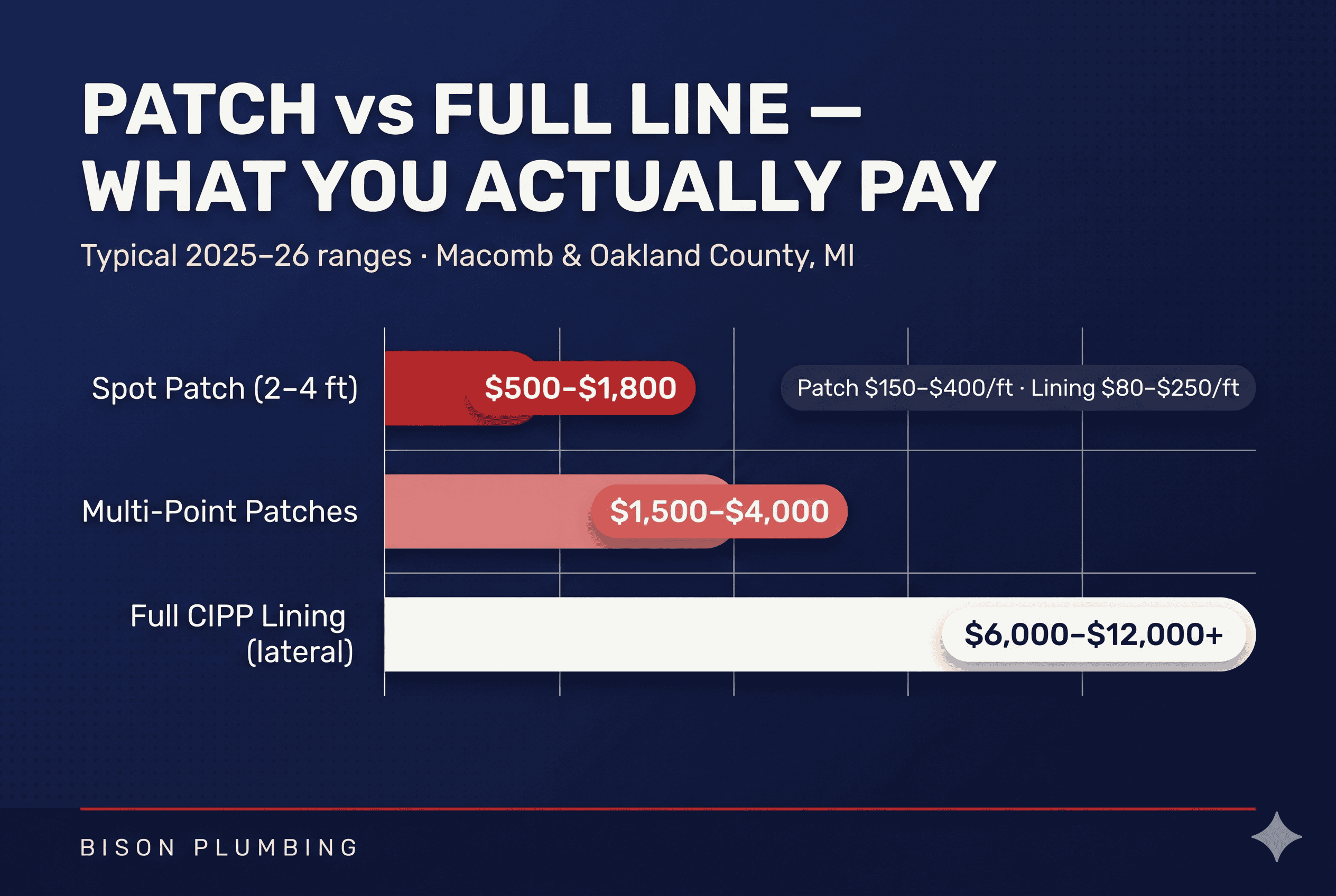
| Repair Type | Typical Cost | Best For |
|---|---|---|
| Spot Patch (2–4 ft section) | $500–$1,800 | One isolated crack, joint, or root entry point |
| Multi-Point Patches | $1,500–$4,000 | A few separate defects in an otherwise sound line |
| Full CIPP Lining (whole lateral) | $6,000–$12,000+ | Widespread damage, aging pipe, recurring backups |
| Per-foot rate | Patch $150–$400/ft · Lining $80–$250/ft | Lining is cheaper per foot; patching is cheaper per job |
Notice the trade-off in that last row: patching costs more per foot, but because you’re only repairing a few feet, the total is far lower. Lining costs less per foot but covers the whole run, so the total is higher. That’s exactly why matching the method to the actual damage matters so much — and why an accurate trenchless repair estimate always starts with a camera inspection, not a guess.
A few factors push costs up or down for both methods: how easy it is to access the line (cleanouts keep costs down, while creating new access pits raises them), pipe diameter, total length, and how much cleaning or root removal the line needs before the repair. Many homeowners spread the cost using financing with $0 down.
Not sure if you need a patch or a full line?
A Picote camera inspection shows you exactly what’s inside your pipe — so you only pay for the repair you actually need. Same-day and next-day appointments across Macomb & Oakland County.
📞 Call (248) 247-7707 Get a Free QuoteWhy are Michigan sewer lines especially prone to damage?
Southeast Michigan’s housing stock and climate create a near-perfect storm for sewer line failure — which is part of why so many homeowners here face the patch-vs-line decision in the first place.
Many older Macomb and Oakland County homes still run on clay laterals with joints every few feet — prime targets for cracks and root intrusion.
Established trees send roots toward the moisture in sewer lines, prying open joints and eventually filling the pipe.
Repeated ground freezing and thawing shifts soil and pipe, causing offset joints and stress cracks over time.
Cast iron lines scale and corrode from the inside, narrowing the pipe and creating rough surfaces that catch debris.
The takeaway: in a region full of aging clay and cast iron, isolated damage in a single spot is common — but so is a line that’s reached the end of its service life. Only a camera tells you which situation you’re in. If you’re seeing warning signs, our guide on sewer and drain problem symptoms can help you spot trouble early.
How long does each method last?
Durability is where lining pulls clearly ahead — and it’s the main reason lining is often worth the higher upfront cost when the whole pipe is involved.
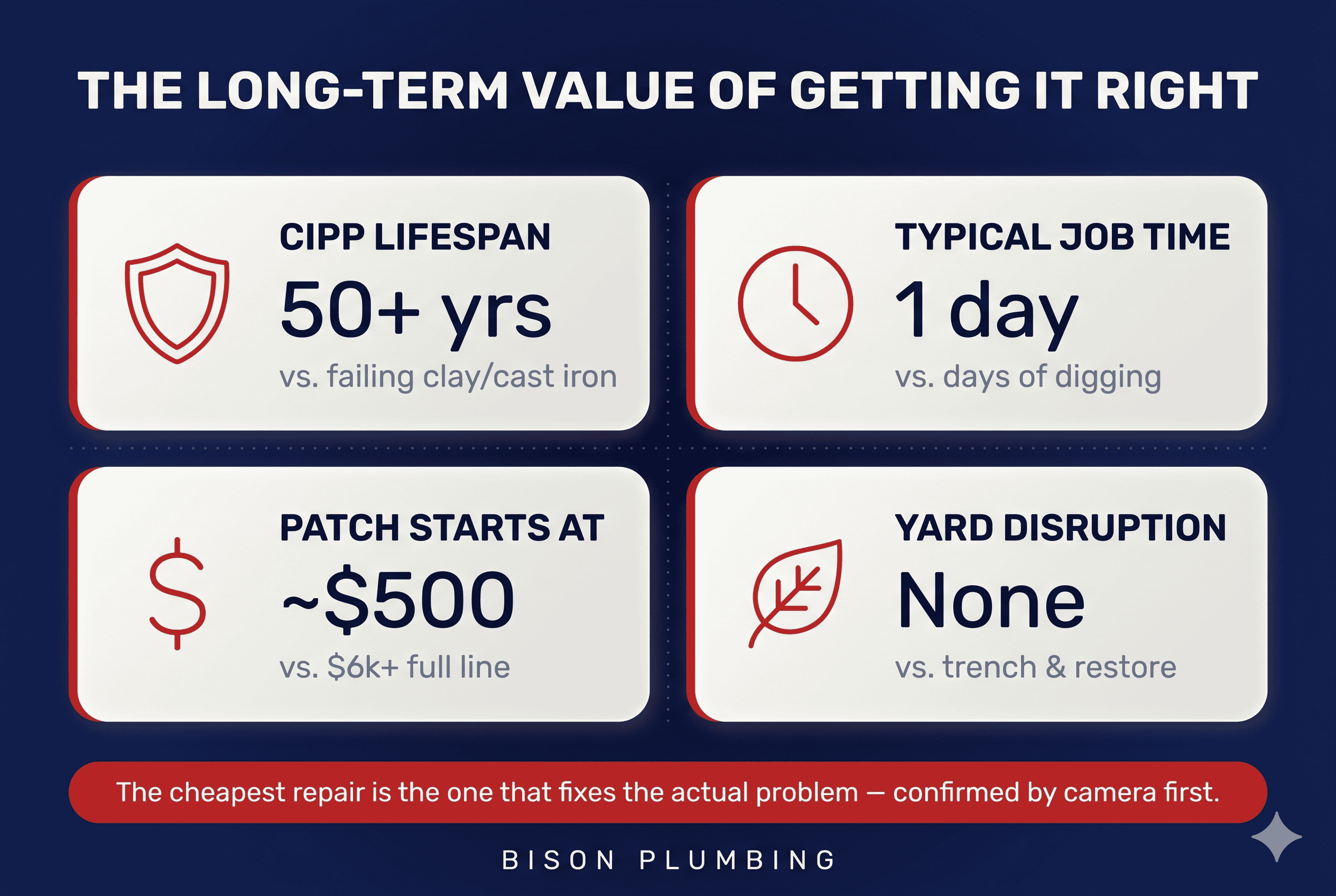
A properly installed CIPP liner has a documented design life of 50 years or more under ASTM standards, and the earliest installations from the 1970s are still in service today. Because the liner is seamless, there are no joints for roots to re-enter — the most common reason repairs fail.
A spot patch, when applied to genuinely isolated damage in a sound pipe, is also a long-lasting, structural repair — not a temporary fix. The catch is that a patch only protects the section it covers. If the surrounding pipe continues to age, new problems can appear next to the patch. That’s why patching shines on a single defect in an otherwise healthy line, and why lining makes more sense when the whole pipe is aging.
The cheapest repair isn’t always the one with the lowest sticker price — it’s the one that fixes the actual problem the first time. A $700 patch that fails in two years because the whole line was deteriorating costs more than lining it correctly upfront.
How do you choose the right method — and the right company?
You don’t have to make this call on your own, and you shouldn’t have to guess. The decision should always be driven by what a camera actually shows inside your pipe. Here’s what a trustworthy process looks like:
- Camera inspection first. Any reputable contractor will run a sewer camera inspection and show you the footage before recommending a repair. You should see the damage with your own eyes.
- A method matched to the evidence. One isolated defect points to a patch; widespread or end-of-life damage points to lining. Be cautious of anyone quoting a full line for a single crack — or a patch for a pipe that’s failing throughout.
- Proper certification. CIPP work should meet ASTM F1216 and F1743 standards and be performed by trained, certified installers.
- Upfront pricing. You should get a clear quote with no hidden fees before any work begins.
Bison Plumbing’s technicians are APSTA-certified trenchless installers using Picote Solutions equipment, and every job starts with a camera diagnosis so the repair fits the problem. Explore all our no-dig sewer repair options, or see a real Ferndale clay-pipe root-intrusion lining job we documented start to finish.
◆ TL;DR — Pipe Patching vs Pipe Lining
- Patching repairs one short 2–4 ft section; lining rebuilds the entire pipe.
- Choose patching for a single isolated crack, joint, or root point in an otherwise sound line — roughly $500–$1,800.
- Choose lining for widespread damage, aging clay/cast iron, or repeat backups — about $6,000–$12,000+, lasting 50+ years.
- Rule of thumb: one problem spot → patch; a line failing in several places → line it.
- Michigan homes face extra risk from clay pipe, tree roots, freeze-thaw, and corroded cast iron.
- Next step: Get a camera inspection so you only pay for the repair you actually need — call Bison Plumbing at (248) 247-7707.
Frequently Asked Questions
Is pipe patching just a temporary fix?
No. When a spot repair is applied to genuinely isolated damage in an otherwise sound pipe, it’s a permanent, structural repair bonded to the original pipe. It becomes a “band-aid” only when it’s used on a pipe that’s deteriorating throughout — which is why a camera inspection beforehand is essential.
Why is full pipe lining so much more expensive than patching one crack?
Lining rebuilds the entire length of pipe, while a patch only covers a few feet. Per foot, lining is actually cheaper ($80–$250/ft vs $150–$400/ft for patching), but because it covers the whole run, the total project cost is higher. You’re paying for a complete, seamless new pipe versus a single targeted repair.
Will tree roots come back through a patch?
A patch seals the specific joint or crack where roots entered, so roots won’t return through that spot. However, if your line has multiple vulnerable joints, roots can intrude elsewhere. For pipes with widespread root problems, seamless CIPP lining eliminates the joints entirely and is the more durable solution.
Can any sewer pipe be lined, or do some need to be dug up?
Most cracked, corroded, or root-damaged pipes can be lined as long as the pipe still holds its basic shape. If a pipe has fully collapsed or lost too much structure, lining isn’t possible — in those cases trenchless pipe bursting (replacement) or, rarely, excavation is needed. A camera inspection determines which applies.
How long does each repair take?
A spot patch is usually completed in a few hours. A full CIPP lining job on a residential lateral is typically done in a single day. Both are dramatically faster than traditional excavation, which can take several days plus time to restore your yard or driveway.
Does trenchless repair really avoid digging up my yard?
Yes. Both patching and lining are performed through existing access points like cleanouts, so there’s little to no excavation. Your lawn, driveway, and landscaping stay intact — one of the biggest advantages over traditional dig-and-replace sewer repair.
How do I know whether I need a patch or a full line?
The only reliable way is a sewer camera inspection. It reveals the exact location, length, and severity of the damage, plus the overall condition of the pipe. One isolated defect typically calls for a patch; widespread damage or an end-of-life pipe calls for lining. Bison Plumbing shows you the footage before recommending anything.
Does Bison Plumbing offer financing for sewer repairs?
Yes. Bison Plumbing partners with GreenSky to offer financing with $0 down and low monthly payments. Pre-qualification takes about two minutes, so an urgent repair doesn’t have to wait.
Get the right sewer repair — not the expensive guess.
Family-owned since 1998 • APSTA-certified trenchless installers • 3,000+ five-star reviews • Camera diagnosis on every job • Serving Macomb & Oakland County
📞 Call (248) 247-7707 Request a Free Quote⭐⭐⭐⭐⭐ Nextdoor Neighborhood Favorite 2021–2024 — read reviews from your neighbors